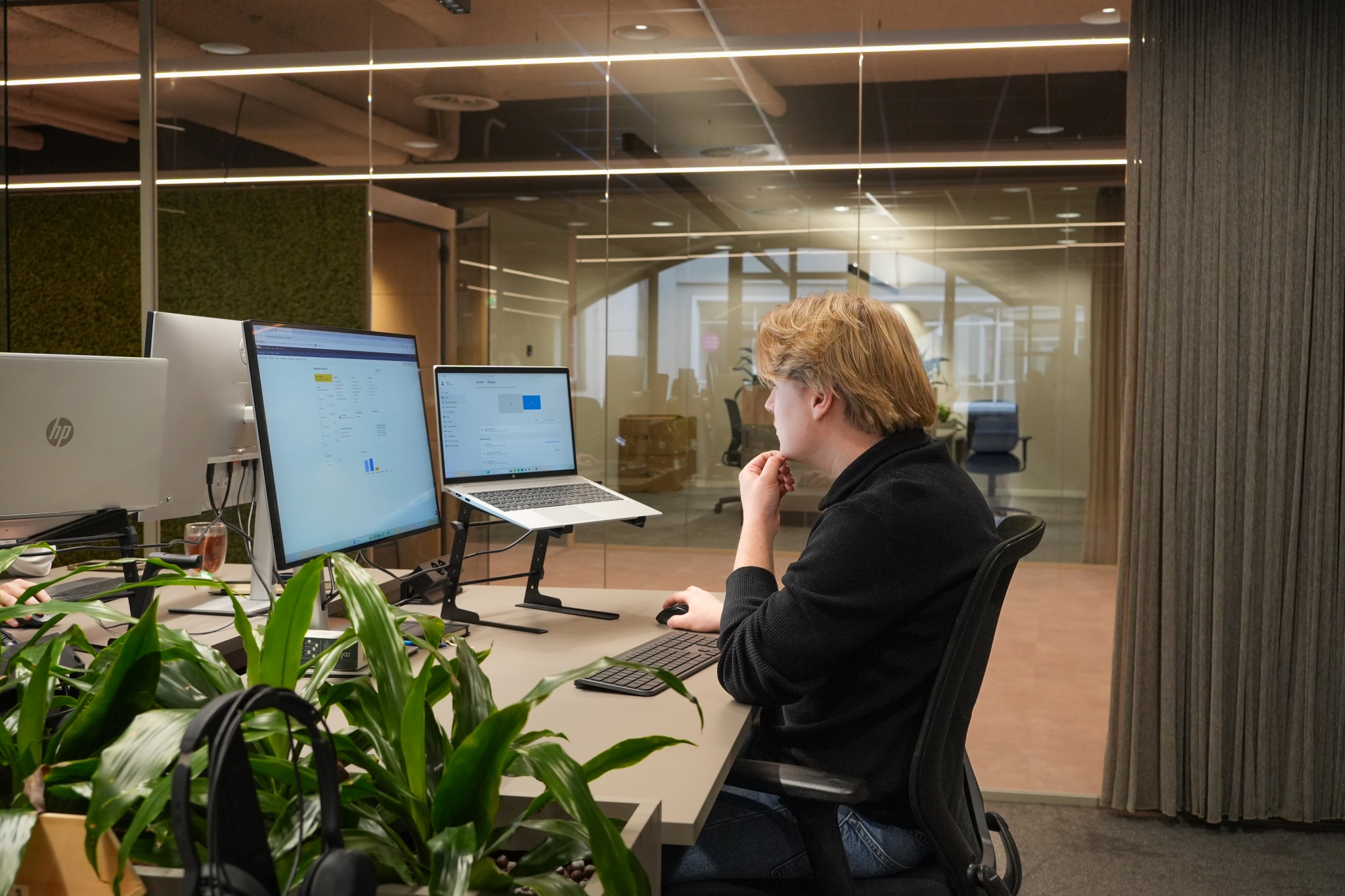
Every so often, we organize a Hackday at Payt. Think of it as a mini hackathon. We still call it a Hackday, but this event has now expanded to nearly two days.
More control and less work. Even in your industry.
Fast and secure invoice processing for every organization.
Fast and secure invoice processing for every organization

Choose your country

A few years ago, we started organizing a one-day hackathon every quarter. The purpose of such a day is to give developers a break from their routine and let them work on self-conceived features or side projects that aren’t necessarily related to Payt’s accounts receivable management software. Most choose to add new functionality to the existing codebase, but there are always one or two teams that take a sidestep by building something that ultimately won’t end up in the codebase.
The hackathon in December 2025
We often play a game of ping pong in between tasks, but the achievements of our enthusiastic players have never been recorded, making it harder to boast about them at the lunch table. Herman and Jasper came up with a solution: a Slackbot that generates and circulates match-ups. The Slackbot also tracks who won or lost. It doesn’t do this automatically yet; the winner must report their victory. After each round, the bot creates new match-ups.
Such an idea emerges a few weeks before the hackathon: everyone can note their idea on the spreadsheet. Other developers can then express their interest in joining a particular project. This way, we can more easily have multiple developers work on one project. Teams generally consist of at least two, but no more than four developers.
One of the goals of a hackathon is for developers to work together as a team. At Payt, we don’t work in teams; each developer is responsible for running their projects and the associated communication. However, the dynamics within a project team are very different from when you’re working independently; there’s a way of consulting, a way of collaborating on a single piece of code, etc.
As I mentioned, most hackathon projects are features applied to existing code, but most projects end up in the trash after such a day, even if they are presented as working during the hackathon. A working demo is a requirement of a hackathon. It’s not a problem if a project ends up in the trash. The goal at the end of a hackathon is achieved: as a developer, you’re distracted from the routine; you’ve learned new technology; and you’ve created fun memories with colleagues you might not work with often.

Some projects continue
Some projects do continue. For example, the CO2 Compensation module. As a Payt customer, you can choose to contribute a certain amount to the Trees for all project. The amount is determined based on the number of invoices, emails, and letters sent per month.
This time, participants worked on:
- Point of sale system for invoices in Payt: This allows for card payments to be made via Payt.
- Remote deploy server: A utility server for orchestrating code deployments.
- Grafana dashboards: A set of digital dashboards displaying graphs of the current state of the application, databases, etc. Such a dashboard should provide quicker insights when an application is struggling.
- Bugmaster bot: A Slackbot that assists the on-duty developer by listing and automating tasks assigned during their shift.
- Payt Wrapped: A Spotify-like year-in-review of sent invoices, cases, and other valuable statistics.
We wrap up such a hackathon with demos and pizzas.

Interested in working at Payt? Check out our current job openings: https://werkenbij.paytsoftware.com/